Best Foundation for a Quonset Hut: Slab vs Stem Wall vs Piers
Best Foundation for a Quonset Hut: Slab vs Stem Wall vs Piers
Published:December 15, 2025
Category:Quonset Hut Steel Buildings
Choosing the right foundation is one of the biggest “make it or break it” decisions for a Quonset hut. It affects your budget, build time, long-term performance, and even how dry your building stays.
Quick answer:
Slab-on-grade is usually the simplest and most popular for garages, workshops, and storage.
Stem wall is a strong upgrade when you need elevation, frost protection, better water control, or you want a clean finished floor height.
Piers (and pier + grade beam systems) can be a smart solution for uneven ground, rocky sites, and certain agricultural uses, but they require careful engineering and bracing.
Below is a clear, field-tested breakdown of each foundation type, what it costs (in real-world ranges), when it makes sense, and how to choose confidently whether you’re a homeowner, farmer, or contractor.
Why Quonset hut foundations matter more than people think
A Quonset hut is an engineered steel arch structure. The building loads are transferred down through the arch and into the foundation through the base connection. If the foundation is weak, out of square, or not built to the right spec, you can run into problems like:
Doors that won’t line up
Water intrusion along the base
Premature corrosion from trapped moisture
Anchor pull-out in high wind zones
Extra labor during erection because nothing fits cleanly
The good news is this: when the foundation is planned correctly, Quonset huts go up fast and stay solid for decades.
The Three Most Common Foundation Options for a Quonset Hut
1) Slab-on-grade (monolithic slab or slab with thickened edge)
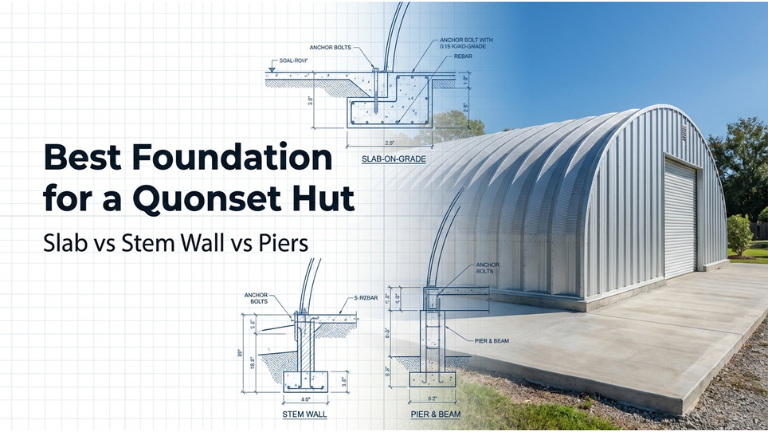
A slab-on-grade is exactly what it sounds like: a concrete slab poured at ground level. Many Quonset hut garages, workshops, and storage buildings sit on a slab because it’s straightforward and cost-effective.
Best for
Garages and workshops
Farm equipment storage
Warehouses and light commercial
Anyone who wants the simplest, most common approach
Typical slab features (common ranges)
Every site and engineer is different, but many Quonset slabs include:
Concrete thickness: often 4″ to 6″ for general use, thicker for heavy equipment
Rebar or wire mesh reinforcement: depends on loads and soil
Thickened edges or turndown footing: common for strength at the perimeter
Vapor barrier: important if you want a drier building and fewer condensation issues
Control joints: to reduce random cracking
If you’re storing heavy tractors, skid steers, pallets, or you’re using vehicle lifts, plan for a heavier slab design. That is not the place to guess.
Pros
Usually the lowest cost of the three options
Fast to build and easy for most concrete crews
Gives you a clean, usable floor immediately
Great for anchoring and sealing along the base
Cons
If your site has water issues, slab at grade can invite runoff toward the building
In cold climates, slab design must address frost and heaving risk
Harder to add plumbing later (not impossible, just more planning)
Cost range (very general)
A basic slab can be one of the more affordable starts, but pricing swings a lot with:
Thickness and reinforcement
Insulation requirements
Excavation and base prep
Local concrete prices
Rule of thumb: slab costs can vary widely, so get a local quote and build from engineered loads, not guesses.
2) Stem wall foundation (footing + short concrete wall + slab inside)
A stem wall foundation uses a perimeter footing below frost depth (when required) and a short concrete wall that raises the building slightly above grade. The slab is often poured inside the stem wall.
This is the foundation choice I see contractors and experienced owners pick when they want the building to sit cleaner, drier, and more “finished.”
Best for
Homeowner garages and workshops where you want a cleaner finished floor height
Sites with drainage concerns or where you need the building slightly elevated
Cold climates where frost depth is a serious factor
Buildings with interior plumbing, better insulation goals, or a more refined interior
Pros
Better water control because you can elevate the base above the surrounding grade
Strong, code-friendly approach in many frost areas
Makes it easier to create a clean slope away from the building
Often pairs nicely with a well-planned vapor barrier and insulation package.
Cons
Typically costs more than a basic slab-on-grade
More steps: excavation, forms, wall, backfill, then slab
Needs careful layout so everything stays square and true
When stem walls really shine
If you’re building on a site where:
Spring melt creates pooling
You have heavy rains
You’re on a slight slope
You want the building floor to sit above the surrounding grade
A stem wall can prevent a lot of headaches. It can also give you a better look at the finished baseline, especially on residential properties.
3) Piers (and pier + grade beam systems)
A pier foundation supports the building on multiple concrete piers (often drilled or dug) rather than a continuous slab or wall. In some designs, piers are connected with grade beams to distribute loads and improve stiffness.
Piers are common in some agricultural settings, remote sites, and uneven terrain situations, but they are not “automatic savings” like people assume. They can be excellent when engineered correctly, and risky when improvised.
Best for
Uneven sites where cutting and filling is expensive
Rocky ground where full excavation is difficult
Certain farm applications where you do not need a full slab
Temporary or phased builds (example: erect building now, pour slab later, if engineered for it)
Pros
Can reduce excavation on challenging terrain
May allow airflow and drainage under the structure in certain setups
Useful where a full slab is not needed right away
Cons
Requires careful engineering for wind uplift and lateral loads
Can be harder to seal against rodents, drifting snow, and wind-driven rain
Often needs grade beams or additional bracing to behave like a rigid base
Floor performance depends on what you build inside later
A practical warning about piers
For Quonset huts, the base connection is critical. With piers, you are asking the structure to transfer loads into discrete points, not a continuous perimeter. That can work, but it is not the place for “good enough.” If you’re considering piers, involve an engineer early and build exactly to plan.
Slab vs Stem Wall vs Piers: side-by-side comparison
Foundation Type
Best For
Cost Tendency
Build Speed
Water Control
Cold Climate Friendly
Slab-on-grade
Garages, shops, storage
$
Fast
Moderate
Yes, with proper design
Stem wall
Elevated, cleaner build, frost areas
$$
Medium
Strong
Strong
Piers (or pier + grade beams)
Uneven sites, special ag uses
$ to $$$
Varies
Varies
Depends on design
Cost depends heavily on soil, excavation, reinforcement, and code requirements. Think of the table as “tendency,” not a bid.
How to choose the best foundation for your Quonset hut
Step 1: Start with your use case
Ask one question first: What will you do in the building every week?
Parking vehicles and wrenching on equipment: you’ll want a solid floor (usually slab or stem wall).
Storing hay or lighter equipment: a slab might still be ideal, but piers could be considered in special situations.
Aircraft hangar: flatness and anchoring consistency matter, often favoring slab or stem wall.
If you’re building a Quonset garage, workshop, barn, or hangar, match the foundation to the day-to-day reality.
Step 2: Respect the soil and drainage
Soil and water are the hidden bosses of every foundation.
Clay holds water and expands.
Sandy soil drains well but can shift if not compacted.
High water tables demand better drainage and elevation planning.
A basic, smart move on almost every site is:
Proper gravel base
Correct compaction
Perimeter drainage planning
Slope away from the building
Step 3: Know your frost line and local requirements
In many states, frost depth is non-negotiable. Local code can dictate:
Footing depth
Insulation requirements
Reinforcement standards
Anchor embedment and spacing
A foundation that works in Texas might fail in Minnesota if it ignores frost movement.
Step 4: Plan your base connection and seal details
A great foundation is more than concrete strength. It’s also:
A flat, level, square surface
Correct anchor layout
Smart sealing at the base to keep water and air out
For Quonset huts, keeping the base dry pays off for decades.
Real-world Recommendations
If you want the simplest, most common foundation
Choose a slab-on-grade, designed for your loads and climate.
If you’re building in a wet area, on a slope, or want a cleaner finished build
Choose a stem wall. It often solves drainage headaches before they start.
If your site is uneven or excavation is a nightmare
Consider piers, but only with proper engineering and a clear plan for bracing, grade beams (if required), and sealing the base area.
Foundation details that make a Quonset hut perform better
Get serious about base prep
Many foundation problems are not concrete problems. They’re prep problems. Good prep includes:
Removing topsoil and organics
Installing a proper gravel base
Compacting in lifts
Verifying grade and squareness
Plan drainage like you mean it
A Quonset hut is tough, but water is persistent. Add:
Positive slope away from the building
Gutters and downspouts (yes, even on steel buildings)
Swales or perimeter drains if needed
Do not “value engineer” Anchors
Anchor layout and embedment matter for wind uplift and long-term stability. Use the engineered plan. If you need to adjust anchor location due to a conflict, get it approved, not guessed.
Common Mistakes (and how to avoid them)
Mistake 1: Pouring first, Engineering later
Always confirm your building specs and foundation requirements before pouring. It is far cheaper to adjust a drawing than to tear out concrete.
Mistake 2: A slab that is not square or not level
Steel buildings expose layout errors fast. Make sure your contractor checks:
Diagonal measurements (squareness)
Elevation consistency
Flatness where doors will be installed
Mistake 3: Ignoring water around the base
Even a perfect slab can become a problem if the grade slopes toward the building. Water management is part of the foundation system
FAQs: Quonset hut foundation questions people ask all the time
What is the best foundation for a Quonset hut garage?
For most garage builds, a reinforced slab-on-grade is the go-to choice. If you have drainage issues or want the floor elevated, a stem wall is often worth the upgrade.
Can I build a Quonset hut on piers instead of a slab?
Sometimes, yes, but it should be engineered specifically for piers. Quonset huts handle loads differently than a typical stick-built shed. Piers can work well on challenging sites, but they require careful planning for uplift, lateral loads, and base sealing.
Do I need a footing for a Quonset hut?
In many areas, yes, especially where frost depth is a factor. Some slabs are designed with thickened edges that act like a footing. Local code and the engineered plan should decide this.
Should I insulate under a Quonset hut slab?
If you want a more comfortable interior, reduced condensation, or you plan to heat the building, under-slab insulation can help. The right approach depends on climate, use, and code.
How thick should my Quonset hut slab be?
It depends on what you’re putting on it. Light storage is different from tractors, lifts, or pallets. A local engineer or concrete pro should design thickness and reinforcement based on loads and soil.
Final Takeaway
If you want the “best foundation,” don’t chase the most popular option. Choose the foundation that fits your site, your climate, and your intended use.
Slab-on-grade: best all-around value for most garages, shops, and storage buildings
Stem wall: best for elevation, drainage control, and many frost-region builds
Piers: best for special sites and specific use cases, but must be engineered carefully
If you want, this topic pairs perfectly with internal pages like Quonset hut models, garages, barns, hangars, and an installation or buyer’s guide. Link this article to those pages, and also link back here from your installation and site prep content.
Frequently Asked Questions
No. Our steel arch buildings can be erected on as little as a footing and slab can be poured at a later date, Asphalt, wood bases, concrete and even I-beams have been used to mount buildings.
No. Our steel arch buildings can be erected on as little as a footing and slab can be poured at a later date, Asphalt, wood bases, concrete and even I-beams have been used to mount buildings.
To the victims of Hurricane Helene and Milton, we want to express our support during this difficult time. If you choose to place an order with us, we will expedite processing to ensure you receive your building as quickly as possible;